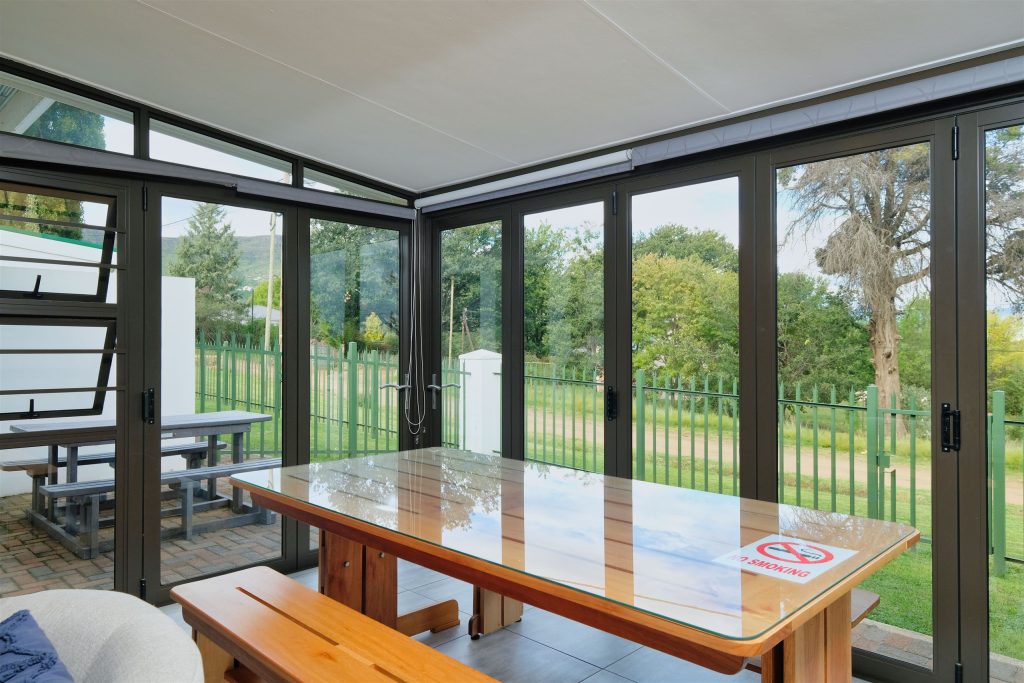
Dinner is over, a school bag is waiting by the dining table, and someone is finishing a worksheet under the pendant light. From the sofa in a Singapore condo living room, you look towards the balcony. Beyond the sliding glass door are the evening lights you enjoy—but the room may also appear in the glass.
That is the view worth considering when choosing the door’s glazing. A daylight photograph can show the frame and outdoor scene beautifully without showing what you will see after work, with the living room in use.

Look from the seat you actually use
On an ordinary evening, spend a few minutes in your usual seat with the door closed and the household’s normal lights on. Notice what competes with the outdoor view. Is it the dining pendant, a brightly lit wall, or an image from the television? Move to another seat only if you would also choose it on an ordinary evening.
Vitro’s guidance on glass reflectivity explains that interior reflectivity matters for views out, and that the lighting on both sides affects what is seen. With interior lights on at night, room reflections can become part of the view. That is a reason to consider the evening setting, rather than judge the proposed glass from a sunny exterior image.
Use the existing door to understand the room’s lighting pattern. It cannot tell you exactly how a different glass construction will look. Nor does a reflection, by itself, establish that the existing pane is defective.
Keep a living room you can still enjoy
Compare lighting arrangements the family could comfortably keep. Using the ordinary controls, try one change at a time while leaving the room suitable for its usual activities. Perhaps an optional decorative light can stay off while the dining light remains needed for homework. Perhaps everyone prefers the present lighting and accepts more of the room in the glass.
The lighting manufacturer ERCO describes how brightly lit surfaces and visible luminaires can create reflections when looking out at night. Its planning discussion supports considering the room as well as the glazing; it does not provide a guaranteed arrangement for your flat.
Turning everything off is not a useful comparison if it leaves a room nobody wants to use. Keep the lights needed for reading and moving around. If a useful improvement would require changing fixed lighting, discuss it with an appropriate lighting professional instead of treating a quick switch-off as the finished plan.
Bring the evening into the glass choice
When considering a large sliding glass door, explain where you sit and which lights will normally remain on. Ask the supplier to identify the proposed glass construction and provide its relevant room-side reflectance and visible-light transmission information. Those details are more useful than choosing by “clear” or “dark” alone, but they still do not predict every evening view by themselves.
Ask what sample or viewing arrangement is available for the proposed glazing, and how closely it represents the quoted construction and your intended conditions. Our glass-appearance guide covers identifying a specific glass build-up; a small sample or a different installed pane does not necessarily represent yours.
Keep the evening requirement alongside the other reasons for choosing the door. A darker-looking sample is not a guarantee of a better night view. The useful choice is one you can assess with the lighting your family actually needs, from the place where you will enjoy looking outside.