Quick answer: Window condensation forms when moist air meets glass or frames that are colder than the air’s dew point. Condensation on the room side usually calls for humidity control, airflow and warmer interior surfaces. Moisture outside may be harmless, while fog trapped between sealed glass panes normally needs professional assessment.
Before replacing a window, identify where the moisture is located. Indoor condensation, outdoor condensation and moisture between panes have different causes and solutions. This guide helps homeowners and project teams diagnose window condensation without confusing it with rain leakage.
Table of contents
- Identify where the condensation appears
- Seven causes and practical fixes
- Room-by-room checklist
- When to repair or replace
- Frequently asked questions
First identify the location of the window condensation
- Room-side surface: indoor moisture is reaching a cold internal surface.
- Outdoor surface: warm, humid outdoor air is reaching externally cooled glass.
- Between panes: a sealed insulating glass unit may have lost its edge seal.
- Around the frame after rain: investigate water leakage rather than assuming condensation.
The United States Environmental Protection Agency (EPA) explains that warm air holds more moisture than cold air, so vapour can condense when humid air contacts a cold surface. ENERGY STAR likewise notes that interior condensation forms when the internal glass surface is below the dew point of indoor air.
Seven common causes of window condensation
1. Indoor humidity is too high for the surface temperature
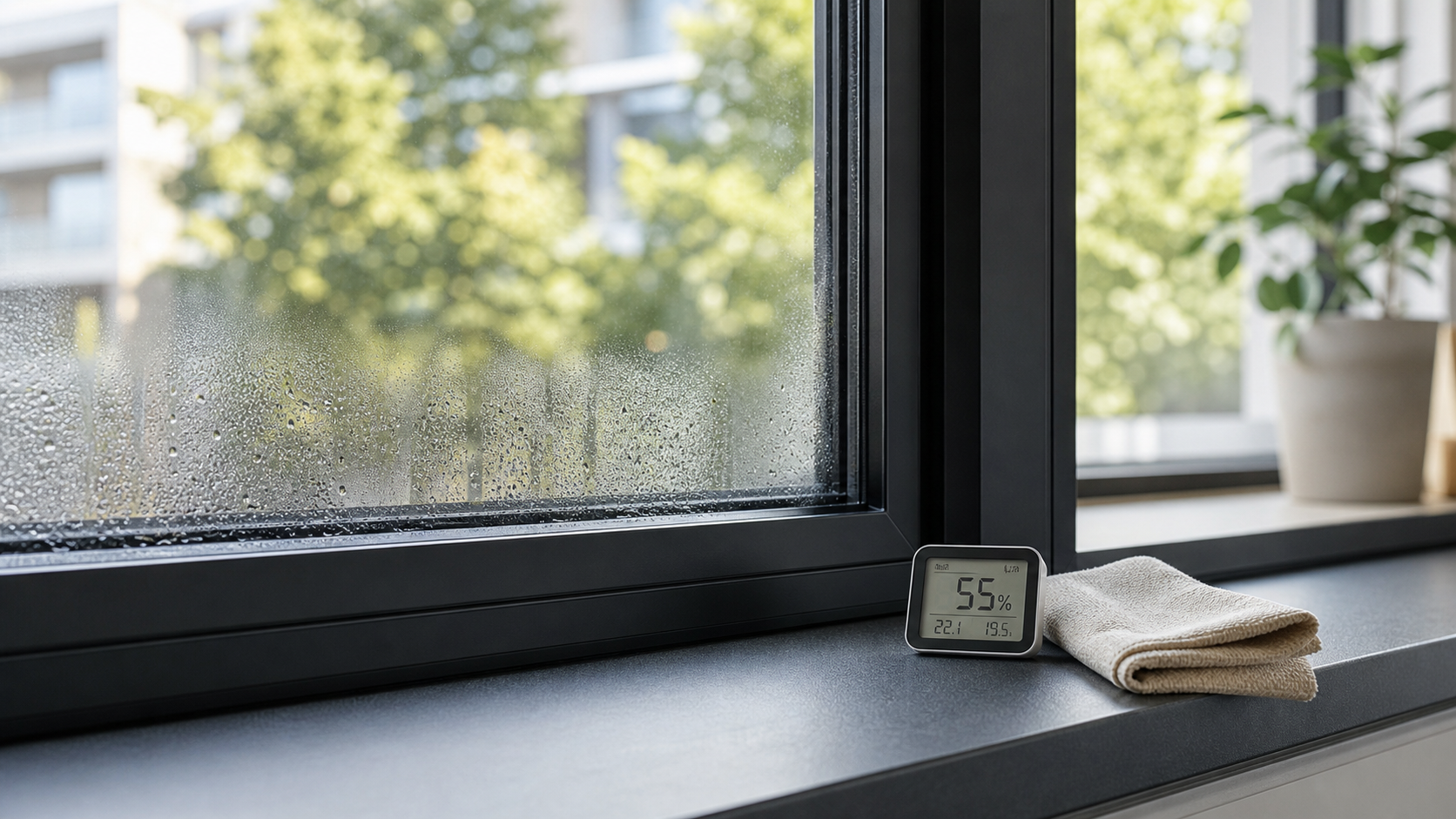
Cooking, showers, clothes drying, plants and occupants all add moisture to indoor air. Use a hygrometer to record relative humidity near the problem room rather than guessing. The EPA recommends keeping indoor relative humidity below 60% and ideally between 30% and 50%, while recognising that climate and building operation affect the appropriate target.
2. Moisture-producing rooms lack effective exhaust
A bathroom or kitchen fan that does not exhaust outdoors may simply move humidity to another space. Use extraction while showering or cooking and confirm that ducts and outlets are functioning. ENERGY STAR advises allowing kitchen and bathroom fans to continue for about 20 minutes after the moisture-producing activity ends.
3. Air cannot circulate across the glass
Closed blinds, deep curtains or furniture can isolate the window from room air and leave the surface colder. Open treatments enough to allow circulation, especially overnight or during cold weather. Do not block required ventilation openings, and keep absorbent fabrics from resting against wet frames or sills.
4. The window has significant thermal bridging
Highly conductive frame sections and edge zones can become colder than the centre of the glass. A thermally broken aluminium frame separates inner and outer metal paths with a less conductive barrier. For new projects, assess the complete window’s U-factor and condensation resistance—not only the centre-of-glass value.
5. Air leakage is cooling parts of the assembly
Gaps at the sash or frame-to-wall joint can create cold spots in heating climates and admit humid outdoor air in cooling climates. Check seals, locking pressure and perimeter joints. Repairs must preserve drainage and use compatible materials, so do not cover every opening with sealant.
6. The insulating glass edge seal has failed
A persistent cloudy or wet appearance between panes cannot be wiped from either side. It may indicate that moisture has entered a sealed glass unit. A glazing professional can confirm the diagnosis and whether the insulated glass unit can be replaced while retaining a serviceable frame.
7. The moisture is actually a leak
Condensation is normally distributed across a cold surface; leakage often appears along a joint during or after rain. Photograph timing, wind direction and the first wet point. Read our guide to common window problems and have drainage, seals and the surrounding wall checked when the pattern follows rainfall.
Diagnostic rule: Moisture location + timing + weather conditions are more useful than the size of the final puddle.
Window condensation checklist
- Wipe the surface dry and confirm which side becomes wet again.
- Record indoor temperature and relative humidity for at least 24 hours.
- Note recent showering, cooking or indoor clothes drying.
- Test whether the kitchen and bathroom exhaust fans operate.
- Open curtains or blinds to improve airflow across the glass.
- Inspect gaskets, locks and frame joints without dismantling them.
- Check whether the moisture follows rain, cooling or cold outdoor conditions.
- Dry wet sills and nearby finishes promptly.
What window ratings help reduce condensation?
For projects that use National Fenestration Rating Council data, U-factor describes heat transfer through the product and condensation resistance indicates resistance to water build-up. ENERGY STAR describes condensation resistance on a scale from 0 to 100, where a higher rating indicates better resistance under the test method. These ratings support comparison but do not eliminate the need to manage humidity.
Glazing, spacers, frame design, opening type, seals and installation all affect interior surface temperatures. Compare complete, tested assemblies in the required size. Explore Forge Windows’ casement windows and sliding windows when preparing a replacement brief.
When should a condensation problem lead to replacement?
Replacement may be appropriate when sealed glass has failed, frames are distorted, seals and hardware cannot be restored, or the existing assembly cannot meet the project’s thermal and moisture-control requirements. If room-side condensation occurs across several windows, investigate indoor humidity and ventilation first; new windows alone may not solve the underlying moisture load.
Frequently asked questions
Is condensation on aluminium windows normal?
It can occur whenever the frame or glass temperature falls below the dew point of nearby air. Occasional exterior condensation may reflect weather conditions, while repeated interior wetting calls for humidity, airflow and surface-temperature checks. Moisture between sealed panes is a separate defect requiring professional assessment.
Does condensation mean my window is leaking?
Not necessarily. Condensation forms from water vapour and often coats a cold surface; leakage usually follows rain and enters at a specific joint or drainage path. Record timing and location. If water appears only during wind-driven rain, arrange a controlled window and façade inspection.
Will double glazing stop all condensation?
Double glazing can keep the interior pane warmer than basic single glazing in heating conditions, reducing risk, but no window prevents condensation under every humidity and temperature combination. Frame edges, spacers, seals, airflow and indoor moisture still matter. Select a complete tested assembly and manage room humidity.
What should I do about fog between glass panes?
Confirm that the fog cannot be cleaned from either accessible surface. Do not drill the glass or dismantle beads yourself. Ask a glazing professional to inspect the sealed unit, identify its specification and determine whether the glass unit can be replaced independently of the frame.
Control the moisture source before replacing the window
The best response to window condensation starts with classification. Find the wet surface, measure humidity, improve extraction and airflow, then assess thermal bridging, air leakage or failed insulated glass. For a new-project review, send Forge Windows the climate, opening schedule, glass specification and room conditions through the contact page.
Sources: US EPA, Main Ways to Control Moisture; US EPA, A Brief Guide to Mold, Moisture and Your Home; ENERGY STAR, Residential Windows, Doors and Skylights.