A loose window handle can come from worn fixing screws, a damaged spindle, a shifted lock mechanism or a sash that is no longer aligned. Tightening a visible handle screw may solve a minor fitting issue, but a handle that spins, lifts away from the frame, or accompanies a loose sash needs professional inspection. Do not keep forcing it.
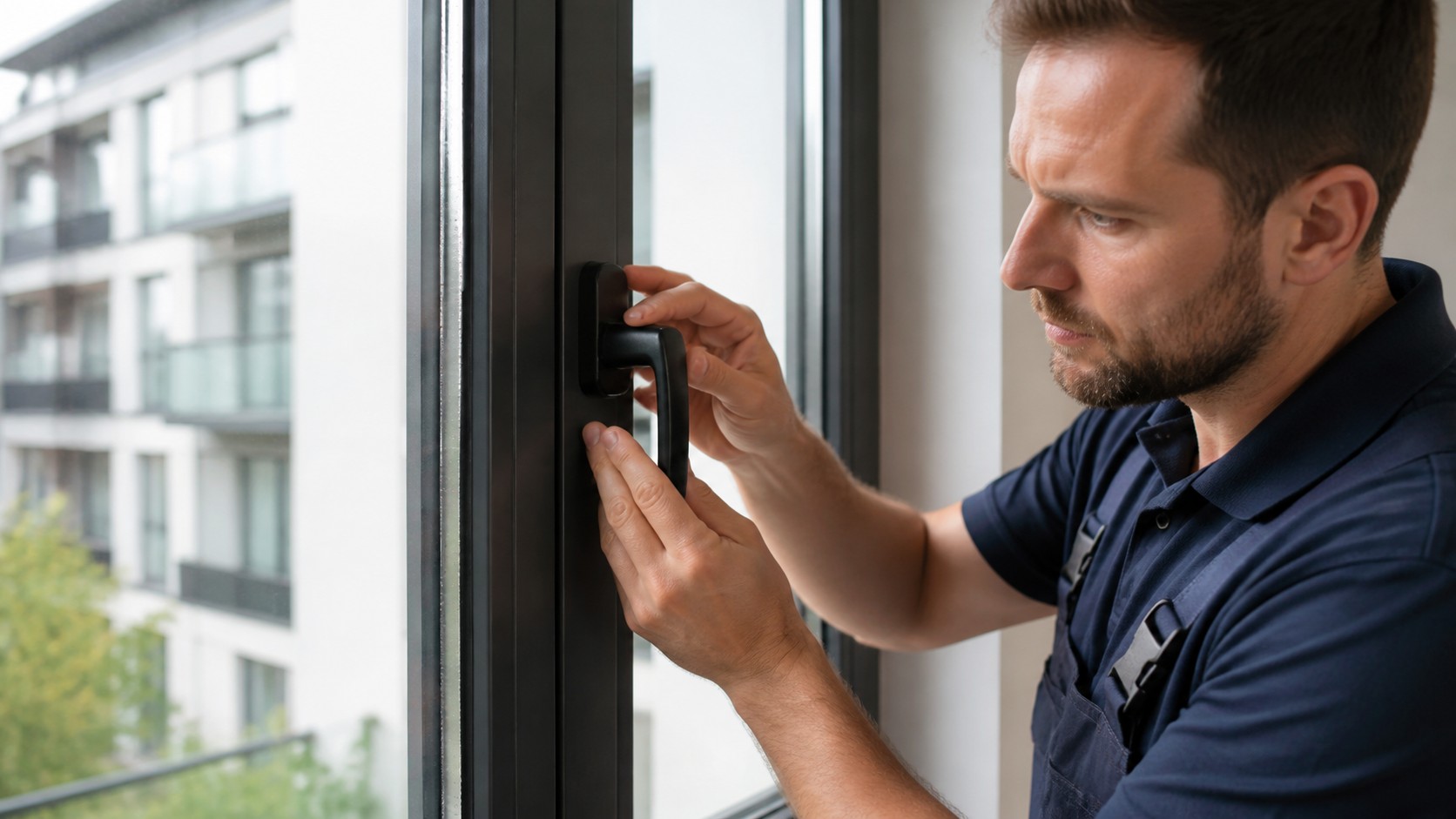
For homeowners and property managers, the key is to separate a local handle problem from a wider window-safety problem. This guide explains the checks you can make from a safe indoor position, the repairs a technician may recommend, and the warning signs that mean the window should stay closed until it is assessed.
Quick check: what exactly is loose?
Close the window gently and observe the handle without pulling hard. Identify which symptom matches:
- The handle wobbles at its base: its cover or fixing screws may be loose.
- The lever moves but the lock does not: the spindle or internal drive may be worn.
- The handle is firm but closing is difficult: the sash, keeper or locking points may be misaligned.
- The whole sash moves: treat this as a support or hardware issue, not a handle repair.
- Rust, corrosion or cracking is visible: stop operating the window and arrange an inspection.
Take one photo of the full window, one of the handle and one of the hinges, stays or sliding track. This gives a contractor the context needed to avoid diagnosing the handle in isolation.
Why a window handle becomes loose
Loose handle fixing screws
Many handles are secured through a base plate. Repeated use can loosen the fixings, especially if the sash needs extra force to close. A decorative cover may hide the screws. If the manufacturer intended the cover to rotate or clip away, the screws can be checked carefully; do not pry an unknown cover with a knife or metal tool.
Worn spindle or internal gearbox
The handle may turn a spindle that drives a lock. Wear, a broken component or an incorrect replacement handle can create free play. If the lever spins without engaging the locking points, tightening the base will not repair the internal mechanism. The correct part must match the original dimensions and operating direction.
Misaligned sash and keeper
A dropped or distorted sash can put extra load on the handle because the locking tongue or mushroom cams no longer meet their keepers cleanly. The symptom may be worst at one corner. Scuff marks, uneven gaps and a handle that works when the window is open but resists when closed are useful clues.
Dirt or corrosion in moving parts
Debris can obstruct tracks and locking points. Corrosion can make hardware stiff or reduce the strength of fasteners. Singapore’s Building and Construction Authority (BCA) advises checking that casement-window rivets are not broken or corroded, screws are not loose or rusty, and friction stays are not bent or loose.
The wrong previous repair
An unsuitable handle, oversized screw, adhesive or excessive lubricant can hide the original fault and damage the mounting area. Replacement hardware should match the window system. Do not drill new holes into the frame without confirming what is behind the profile and how the window is supported.
Loose window handle: safe checks and next steps
| Symptom | Likely area | Next step |
|---|---|---|
| Only the handle base wobbles | Handle fixings | Check accessible screws if the cover is designed to open |
| Lever turns without resistance | Spindle or lock drive | Keep the window closed and replace the correct mechanism |
| Handle binds only when closing | Sash or keeper alignment | Inspect margins and locking points; do not force |
| Sash, stay or hinge moves | Support hardware | Stop using the window and call an approved contractor |
| Rusty or loose fastener | Safety-critical connection | Professional replacement with the specified part |
Can you tighten it yourself?
A homeowner may tighten a clearly accessible handle-base screw when the sash and all support hardware are stable, the screw is not corroded, and the manufacturer intended routine access. Use the correct screwdriver, support the handle, and stop when the screw is snug. Overtightening can strip the thread, crack the base or distort the mechanism.
Do not remove hinges, friction stays, rivets, safety stoppers or a window panel. Do not lean outside a high-rise opening. BCA states that window replacement and retrofitting must be performed through approved window contractors or builders with trained window installers.
How a technician may repair a loose window handle
- Confirm the window type and hardware: casement, awning, sliding and louvred systems use different components.
- Inspect sash support and alignment: a new handle should not be fitted before the cause of extra closing force is corrected.
- Test the spindle and locking points: damaged internal parts are replaced with compatible items.
- Repair the mounting: stripped or damaged fixing points need an appropriate system repair, not a larger random screw.
- Check full operation: the sash should close without force and the lock should engage consistently.
If the frame is distorted, hardware is obsolete or corrosion is widespread, replacement may be more sensible than repeated small repairs. Compare suitable casement windows and sliding windows based on safe operation, ventilation and maintenance access.
What not to do
- Do not force the handle through a stiff point.
- Do not use pliers to gain extra leverage.
- Do not glue a moving handle to the frame.
- Do not spray lubricant into an unknown lock mechanism.
- Do not replace safety hardware with an unverified screw or rivet.
- Do not keep opening a sash with loose, rusty or bent supports.
Preventing repeat handle problems
Clean tracks and contact points, operate locks gently and investigate new resistance early. Check the handle, keepers, screws and support hardware at least as part of your regular window-maintenance routine. BCA’s current guidance uses a simple “check, clean, change” approach and recommends engaging an approved contractor when you are not confident performing the inspection.
Frequently asked questions
Why is my window handle loose after I tightened it?
The screw may be stripped, the mounting surface damaged, or the sash may be loading the handle because it is misaligned. Repeated tightening can enlarge the damage. Stop when a screw no longer becomes snug and have the handle, lock and sash alignment assessed together.
Can a loose handle make a window unsafe?
A local handle wobble is not automatically a falling-window risk, but it can prevent secure locking or signal that extra force is being applied. If the sash, stay, hinge, rivet or frame also moves, treat the condition as safety-critical and stop operating the window.
Can I replace only the handle?
Yes, when the lock mechanism, mounting and sash alignment are sound and a compatible replacement is available. The spindle length, screw centres and operating direction must match. Replacing only the handle will not solve a worn gearbox, damaged keeper or distorted sash.
Should the window stay open for ventilation?
Not if the handle cannot secure it or the support hardware is questionable. Use another safe ventilation route until the window is assessed. Do not wedge an unstable sash open, especially in wind or where children can reach it.
Conclusion
A loose window handle is often repairable, but the correct fix depends on whether the movement is in the handle, lock, sash or support hardware. Make only safe indoor checks, never force the lever, and stop operating the window when you see rust, looseness or movement beyond the handle itself.
For a repair or replacement assessment, contact Forge Windows with photos of the whole window, the handle and the support hardware.
Sources: Singapore BCA — What to Look Out For When Checking Windows; Singapore BCA — Window Maintenance Tips; Singapore BCA — Windows Safety.