Quick answer: If your folding door won’t close, stop pushing when the panels resist. Check that every handle and flush bolt is in the correct operating position, then inspect the top and bottom tracks for debris. Uneven panel gaps, scraping, a lock that misses its keep or a panel that appears to drop can indicate roller, hanger, hinge or alignment problems. Clean accessible dirt, but leave panel-height and hardware adjustments to a technician familiar with the door system.
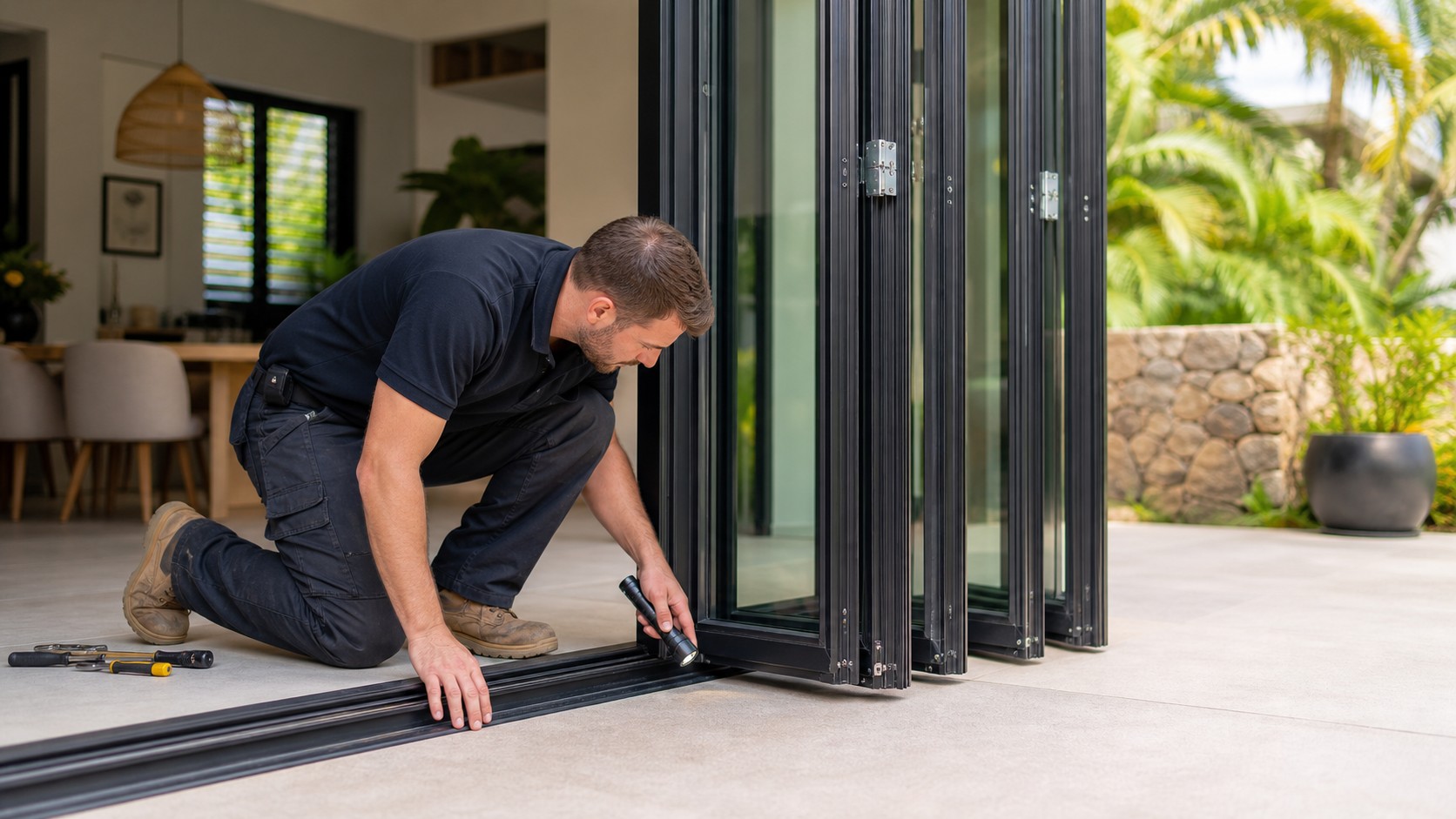
Folding doors combine several connected panels, hinges, guides, rollers and locking points. A small fault at one location can travel through the whole set and make the final panel difficult to close. This practical guide helps homeowners, facilities teams and project buyers diagnose why a folding door won’t close without forcing expensive components.
Table of contents
- Check the operating sequence first
- Seven reasons a folding door will not close
- Symptoms and likely causes
- Safe cleaning and maintenance
- Frequently asked questions
Folding door won’t close? Check the operating sequence first
Multi-panel systems do not all operate in the same order. Some include a traffic or access door that must close before the folding leaves. Others require intermediate handles or flush bolts to be released before opening and re-engaged in sequence when closing. A panel catch may also need to hold leaves together during movement.
Use the manufacturer’s instructions if available. Without forcing anything:
- Move children, pets and objects clear of the panels and pinch points.
- Check whether the traffic door is supposed to close first or last.
- Confirm all handles are in their intended movement position.
- Look for bolts that remain extended into the track or head.
- Guide the panels slowly while watching the top and bottom clearances.
- Stop at the first point of resistance, scraping or panel lift.
Do not force the handle: a lock that will not engage often reflects panel misalignment. Extra force can damage the gearbox, keeps, connecting rods or handle without correcting the geometry.
Seven reasons a folding door won’t close
1. Debris is blocking the track or guide channel
Dust, grit, leaves, small stones and renovation debris can obstruct rollers and guides. Senior Architectural Systems’ folding-door maintenance manual advises keeping top and bottom tracks free of foreign objects and stopping to inspect if resistance is felt. Even a small hard particle can make a loaded roller climb, skid or transmit a jolt through several panels.
Vacuum with a narrow attachment and wipe using a dry, non-abrasive cloth. Do not use a screwdriver to scrape finishes or push debris deeper into drainage channels.
2. A flush bolt or locking point is still engaged
Folding sets may use flush bolts at intermediate leaves and a multi-point lock at the closing panel. If a bolt remains extended, the door can stop abruptly or appear out of square. Check the visible position of handles and bolts; do not dismantle the lock or repeatedly cycle a handle that feels jammed.
3. One panel has dropped or settled
Uneven gaps, scraping at the threshold and a lock that sits below its keep can indicate vertical settlement. The cause may be adjustment at a hanger or pivot, wear in a roller, loose fixings or movement in the frame. The correct adjustment points and load path vary by system, so random turns on visible bolts can worsen alignment or unload the wrong component.
4. Rollers, guides or bearings are worn
Folding panels depend on smooth movement at multiple carriages. A damaged wheel, bearing or guide can create grinding, jerky travel or sideways movement. Check for metal particles, flat spots, unusual noise and a panel that lags behind the rest. Loaded rollers and hangers should be replaced or adjusted with the panels safely supported.
5. Hinges or fixings are loose
Hinges keep the panels working as a coordinated set. Loose screws, worn pins or movement at a bracket can change the gaps from one leaf to the next. Manufacturer maintenance guidance commonly calls for checking fixings for security and wear. If a panel sags, a hinge gap opens or a fixing pulls from the frame, stop using the door until inspected.
6. Seals are displaced, swollen or folded over
Weather gaskets must meet evenly without catching between panels. A seal pulled from its groove can bunch at a corner and prevent the door reaching the lock. Dirt and sticky residue can have a similar effect. Clean with mild soapy water and a soft cloth when permitted by the manufacturer’s care guide. Replace damaged profiles with compatible parts rather than cutting them away.
7. The frame or threshold is out of square
If the building opening moves, fixings loosen or the threshold loses support, local hardware adjustment may not solve the problem. Look for diagonal gap changes, cracked perimeter joints, water ponding or a track that is no longer level. The installer should measure the opening and frame before changing roller height or lock positions.
Match the symptom to the likely fault
| Symptom | Likely area | Safe response |
|---|---|---|
| Door stops at the same track location | Debris, track damage or roller | Clean visible debris; stop if the track is damaged |
| Final panel reaches frame but will not lock | Panel alignment, keep or gasket | Do not force handle; photograph gaps and lock height |
| Panel scrapes at bottom | Settlement, hanger, roller or threshold | Keep panels supported and book service |
| Panels move in a jerky sequence | Roller, guide, hinge or operating order | Check instructions and tracks; stop at resistance |
| Gap changes between hinged leaves | Loose hinge or frame geometry | Avoid further cycling and arrange inspection |
| Seal bunches at a corner | Displaced or incompatible gasket | Do not cut it; clean and request correct replacement |
Safe folding door cleaning and maintenance
- Vacuum loose debris from top and bottom tracks.
- Wipe tracks with a clean, dry, non-abrasive cloth.
- Clean frames and gaskets using the product maker’s approved mild solution.
- Check handles, visible fixings and keeps for looseness or wear without dismantling them.
- Open and close slowly only when the path is clear and the panels remain controlled.
- Keep drainage outlets open and investigate standing water.
- Arrange service when movement, gaps or locking change.
Lubrication instructions differ. Some systems specify a light oil on particular moving parts while requiring the running track to remain free of lubricant; others use a system-specific product. Applying grease or a general spray everywhere can attract grit, affect finishes or make a track unsafe. Follow the door’s care manual or use a qualified service technician.
When adjustment is a professional job
Professional service is appropriate when panels need lifting or support, roller or hanger settings must change, hinges are loose, locks need repositioning, glass is damaged, the frame is out of square or the threshold is moving. Ask the technician to diagnose the cause before adjusting the final lock keep. Moving only the keep can make the lock appear to work while the panels remain misaligned.
If several components are worn or the current configuration no longer suits the opening, compare repair with a correctly specified replacement folding door. For projects needing a wide opening with a different operating pattern, Forge Windows also offers a free-folding window reference for design discussions.
What not to do when a bifold door is stuck
- Do not shoulder, kick or drag the panels through resistance.
- Do not hang body weight on handles or intermediate leaves.
- Do not turn hanger, pivot or roller bolts without system instructions and safe support.
- Do not grind the track or cut gaskets to create temporary clearance.
- Do not flood the track with oil, grease or unapproved cleaner.
- Do not keep cycling a door with cracked glass or visibly loose hardware.
What to send when requesting folding-door service
- A wide photo showing the complete opening and panel arrangement
- Close photos of top guides, bottom rollers, hinges, locks and the point of contact
- A short video of the problem, stopping before force is required
- Overall dimensions, number of panels and opening direction
- The door label, series or previous drawings if available
- When the fault started and whether weather or building work preceded it
- Any water leakage, unusual noise, glass damage or frame movement
Frequently asked questions
Why will my folding door close but not lock?
The final panel may not be aligned with the lock keeps, a gasket may be trapped, a flush bolt may be in the wrong position or the operating sequence may be incomplete. Do not force the handle. Compare the gaps and lock height, then have the panels and frame checked as a system.
Can I adjust a bifold door myself?
Cleaning tracks and following simple user instructions may be reasonable. Adjusting loaded hangers, pivots, rollers, hinges or panel height can release support or shift several leaves. Unless the manufacturer provides a specific owner procedure and you can control the panels safely, use a trained door technician.
Should a folding door track be lubricated?
Not automatically. Some manufacturers require clean, dry running surfaces and specify lubricant only for selected hinges, guides or locking parts. Others have different care instructions. Identify the system first, clean away debris and use only the product and location stated in its maintenance guide.
Why does the folding door keep going out of alignment?
Repeat misalignment may indicate worn rollers, loose fixings, inadequate panel support, frame movement, threshold deflection or an adjustment that treated only the lock rather than the cause. Request measurements of the frame and track plus inspection of the load-bearing hardware before another local adjustment.
Restore the panel geometry before changing the lock
When a folding door won’t close, start with the operating sequence and clean tracks, then look for changing gaps, scraping and displaced seals. Stop before force is needed. Send photos, a short safe video, panel count and dimensions through Forge Windows’ contact page to discuss targeted service or a replacement specification.
Sources: Senior Architectural Systems, Operation and Maintenance Manual; Kolbe Windows & Doors, Operation, Care and Maintenance Manual; Coastal Group, Bifold Door Systems Care and Maintenance Guide.